
Using Artificial Intelligence to Prove the Lost Cause

I’ve seen my share of incoherent and ill-informed social media posts over the years about the Civil War and the Confederacy, but this might just win the award for batshit craziest.
Over the past few years, AI tools like Chatgpt have come to occupy a prominent place in the production of historical content. In February I explored how AI tools can be used to create history videos, which have now come to dominate the history category on YouTube.
Generative AI Interprets Civil War Memory
Thanks for watching the video. I hope it helps to begin to sort out many of the challenges that generative AI poses to how we now consume and create history online.
The takeaway in this video was to proceed with extreme caution, but these tools are here to stay so we need to find a way to utilize them to enhance our work as historians and not as a substitute for the careful thinking and research that will always remain essential.
With that in mind, take a look at this tweet. I will leave it to you to look into this individual’s background if you think it necessary. Let’s just say, she is extremely sympathetic to the Lost Cause narrative—specifically the assumption that enslaved people were overwhelmingly ‘loyal’ to their enslavers and the Confederacy throughout the Civil War.
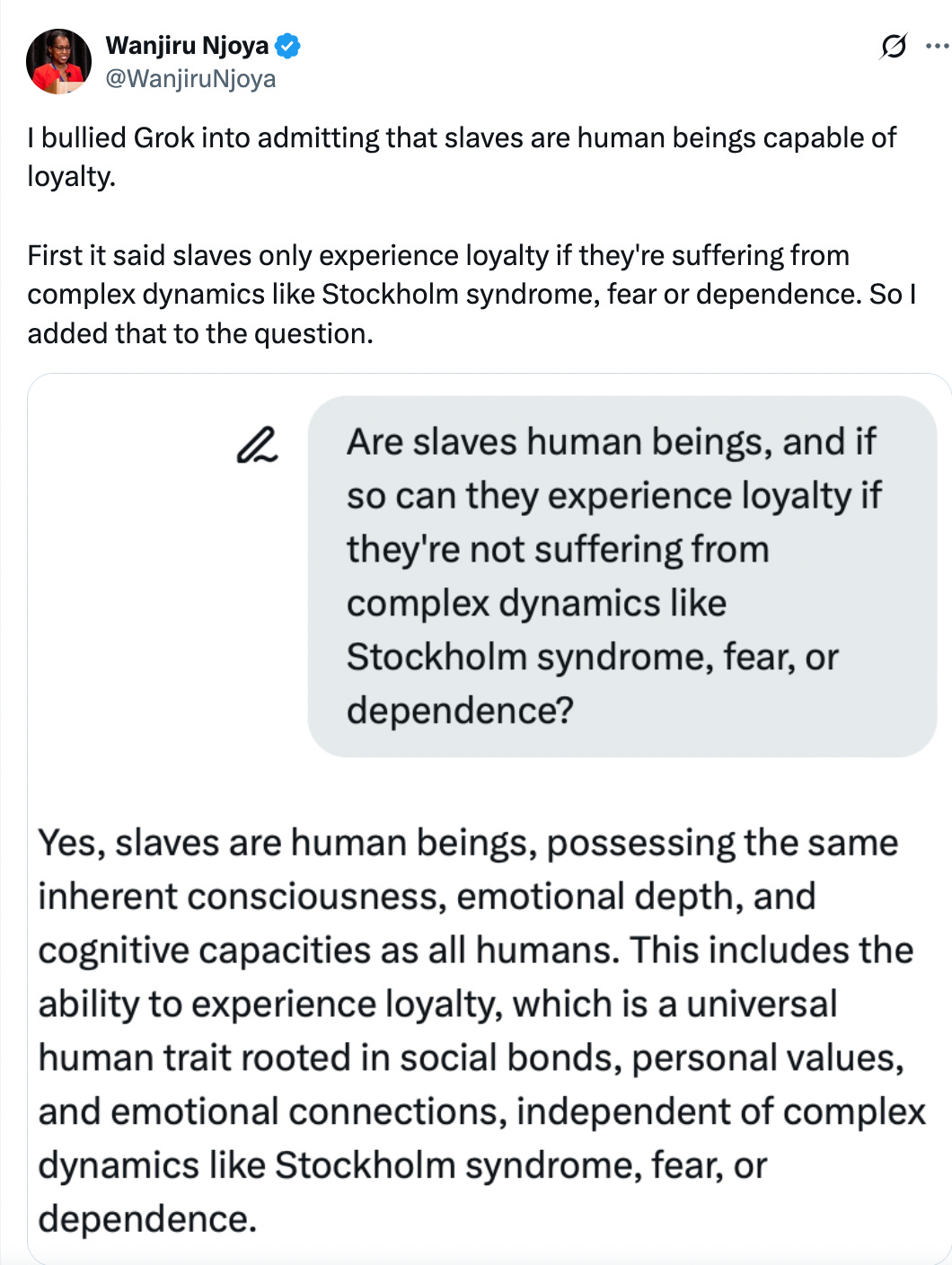
You might ask why it is necessary to ask Grok anything about the loyalty of enslaved people. Of course, as human beings they can experience the full range of other-regarding emotions. We might start by stating the obvious, that like anyone else enslaved people can express their loyalty to their family members, friends, etc.
But this individual appears to be asking Grok or the platform has interpreted this specific query as to whether enslaved people were or can be loyal to their enslavers.
One of the many problems with the Lost Cause narrative is that even as it centers African Americans in a historical narrative, it pushes aside any claim to agency or humanity. The narrative embraces African Americans simply as a means to an end, rather than as actors capable of the full range of thought, emotion, and action that we take for granted when thinking about or engaging with other people.
In this case, AI made it possible for this author to dehumanize enslaved people two-times over, first by embracing the Lost Cause’s ‘loyal slave’ reductionist assumption and second by using an algorithm to help to prove it.
The problem is that this individual fails to recognize enslavement as having been imposed on one person by another rather than as a natural condition.
I think we can safely assume that this has nothing to do with historical thought in any shape or form.
Was Silas Chandler ‘loyal’ to his enslaver Andrew Chandler? First, we would have to define our terms to fit the legal context of one man owning another as well as the ability and legal right to dictate his every action and decision.
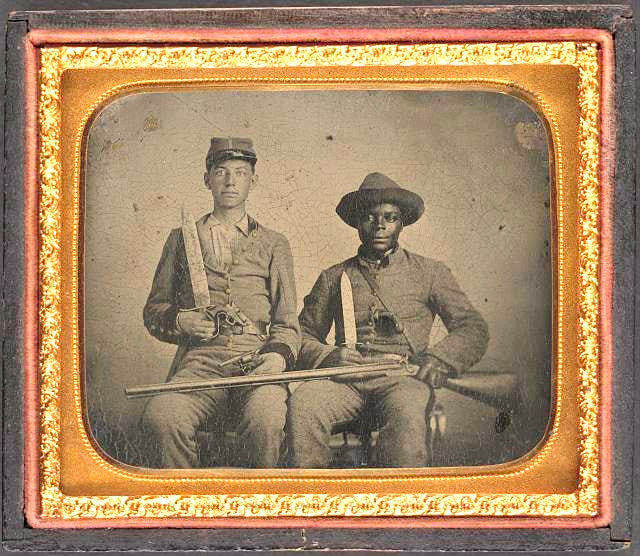
I struggle to make sense of such a concept in this particular context, but I do understand it when exploring Silas’s relationship to his wife, who was waiting for him back home in West Point, Mississippi during the war. I can certainly understand Silas’s return home in the middle of the war in 1863 as an expressio of his love and loyalty for his wife and newborn child, who he would meet for the very first time.
We should have no problem identifying and appreciating Silas’s loyalty to his family as he struggled to exercise his freedom throughout the postwar years in Mississippi, including the building of a life as a property owner and as the head of a growing family, amidst the brutal racial violence and intimidation that defined Reconstruction and the Jim Crow era.
Welcome to the ‘brave new world’ of artificial intelligence, but in this case the problem isn’t with the technology or the answer that this user attempted to ‘bully’ out of it.
The problem is with the belief that the question needed to be asked at all.
Thanks to all of you for the kind words in response to yesterday’s post.
Civil War Memory is the #8 Rising History Newsletter on Substack

I want to thank all of you for helping to make Civil War Memory one of the Top 10 rising history newsletters this week. I couldn’t have done it without you. Just one problem. It irks me to no end to see that I am behind historian Niall Ferguson.
I've noticed others in that world complaining that Musk's Grok doesn't provide the answers they expect or want. Testing it is somehow a thing. The real object lesson here though, it seems to me, is how easily it can be manipulated.
Another excellent post. Edda Fields-Black's outstanding book Combee demolishes the notion that the enslaved were happily singing in the fields. Given the opportunity for freedom they took immediate and conclusive steps toward liberation. Since illiteracy was imposed on the enslaved there are not many contemporaneous records such as diaries and letters, but Fields-Black shows that the narratives can be unearthed and those narratives absolutely give the lie to the Lost Cause narrative.
Keep calling out this garbage "history".