
Congress to Explore Designating the Site of a Confederate Massacre of Black Soldiers as a National Historical Park

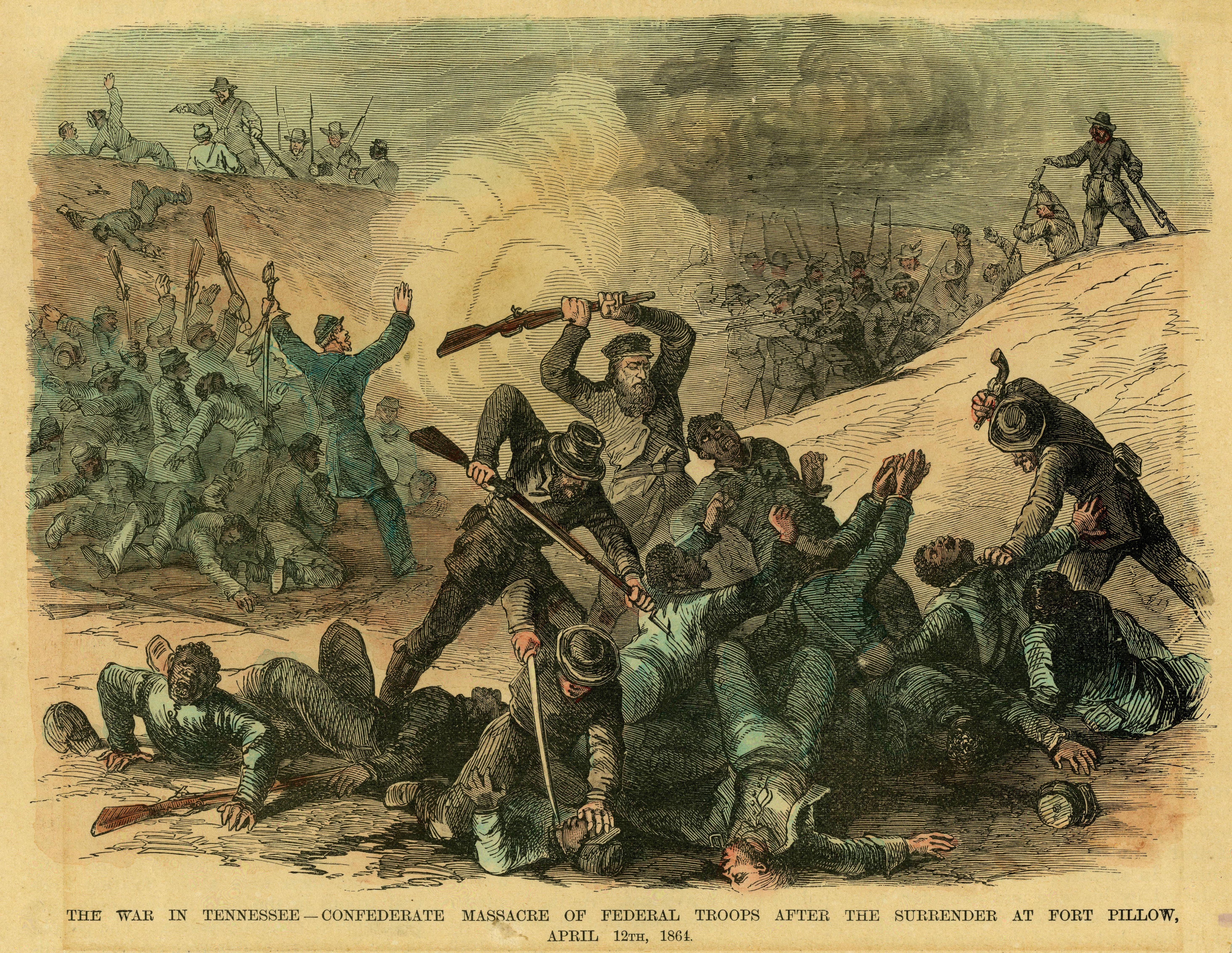
Congress is exploring the possibility of designating the site of the Confederate massacre of hundreds of United States Colored Troops at Fort Pillow, Tennessee as a National Historical Park. This would place it within the Interior Department and under the management of the National Park Service.
It is way too early to predict the outcome, especially given the politics of the moment, but the fact that it is happening at all is a good sign.
The bill is explicit in its acknowledgment of the site’s difficult history:
Congress finds as follows:
(1) Fort Pillow was originally built by Confederate troops in 1861 and named after General Gideon J. Pillow of Maury County, Tennessee.
(2) The battle of Fort Pillow was fought on April 12, 1864, at Fort Pillow in Henning, Tennessee, during the American Civil War.
(3) At Fort Pillow, Tennessee, Confederate forces never defeated the Union Navy. Instead, they perpetrated a heinous massacre after violating a flag of truce by advantageously repositioning rebel troops and by looting government buildings and private storefronts surrounding the fort.
(4) According to the 1864 Report “Fort Pillow Massacre” from the United States Congress Joint Committee on the Conduct of the War, “The officers and men seem to vie with each other in the devilish work; men, women and even children, wherever found, were deliberately shot down, beaten and hacked with sabers. …”.
(5) The Union garrison consisted of 19 officers and 538 troops of whom 262 were United States Colored Troops (U.S.C.T.).
(6) Per the report, “Of the men, from three hundred to four hundred are known to have been killed at Fort Pillow, of whom at least three hundred were murdered in cold blood after the fort was in possession of the rebels and our men had thrown down their arms and ceased to offer resistance.”.
(7) The massacre at Fort Pillow demonstrated to all U.S.C.T. that surrender was not an option. The massacre at Fort Pillow became a rallying cry and motivation for the 209,147 U.S.C.T.
As someone who emphasized the importance acknowledging and understanding the importance of racial massacres on Civil War battlefields in my first book, I applaud this development.
But beyond the massacre itself, there are a number of narrative threads that can be explored with NPS resources. Visitors can learn about the raising of USCTs in Tennessee, the displacement of enslaved people as a result of the war, and finally the role of the federal government in investigating the massacre.
The site complicates our popular understanding of what constitutes a Civil War battlefield and the nature of violence.
Fort Pillow is currently a state park. The park’s website includes a good deal of information and there has been some progress in recent years to place wayside markers and other exhibits that explore the battle, but there is no substitute for depth of interpretation that the NPS can bring to bear at Fort Pillow.
As I stated up front, this study is in the very early stages. It is impossible to predict what will come of it, but I would suggest that it is significant that it is taking place at all. First and foremost, it means that there are still people in the federal government, who believe in a robust NPS that has the opportunity to interpret all of our history.
I will make sure to keep all of you updated.
The incendiary combination of Black men and white southern Unionists, together in arms, represents a central yet generally neglected element of what made the Fort Pillow Massacre a uniquely infamous event in Civil War history. – True Blue : White Unionists in the Deep South
This was a great article, Fort Pillow should be part of the larger conversation in America. I am fearful however that with the emphasis of "brightening up" history to fit the Trump narrative might turn this into something else. It is a dark spot on history and spotlights the Confederate Cause of hate toward Black people. It is a story of heroism, and of cruelty, and anything that reeks of White Supremacist cruelty seems to be destined for erasure by this administration. Keep us all informed about how we can support the National Parks in this designation and in lobbying for truthful signage, not sanitized ones.
added note: someday I would like to research the brave white commanders of Black forces, what the threats of the Confederates against them and those they commanded, and did that affect their lives after the war. We have 2 such men buried in Newport, WA who commanded a Black regiment (?) and are recognized at the National African American Civil War Museum in DC. As far as I could research, these two men were early settlers here and no one seems to remember their past military service. Both the Colored Troops as they were called and their commanders have a special place in my heart in the story of Civil Rights.